

Floating shelves look simple. A board on the wall with no visible brackets. But when they’re installed wrong, they sag, pull away from the wall, or come down with everything on them. If you’re looking into floating shelf installation in West Palm Beach or anywhere in Palm Beach County, here’s what a working contractor looks at before drilling the first hole.
Why Floating Shelves Fail
A floating shelf is a lever. All the weight sits out in front of the wall, and the hidden bracket has to resist that weight trying to pry the shelf down and out. The deeper the shelf and the heavier the load, the more force goes into the fasteners at the back. Most failures come down to a few things:
- Fasteners that only grab drywall, with nothing solid behind them
- Brackets that are too short for the depth of the shelf
- Shelf boards that aren’t drilled straight, so they sit loose on the bracket rods
- Loading the shelf with more than it was built for (books and stoneware are heavier than people expect)
Get the wall right, the bracket right and the board right, and a floating shelf can be very solid. Skip any one of them and it will show eventually.
Know What’s Behind Your Wall
This is where South Florida homes differ from a lot of the how-to videos online.
Concrete Block Exterior Walls
Many homes in Palm Beach County have concrete block (CMU) exterior walls, often with furring strips and drywall on the inside. That gives you a few options. You can anchor through the drywall into the block with masonry screws or sleeve anchors, or you can find the furring strips, though furring alone usually isn’t enough for a heavy, deep shelf. Drilling into block means a hammer drill, the right bit, and care to avoid hitting a hollow cell where an anchor won’t hold well.
Wood or Metal Stud Interior Walls
Interior partition walls are usually wood or light-gauge metal studs. Wood studs are the ideal target for lag screws. Metal studs are thinner and don’t hold a screw the same way, so they call for different fasteners, and sometimes blocking added inside the wall.
Condos and Concrete
In condos and high-rises from West Palm Beach to Delray Beach, you may be dealing with poured concrete walls. Many buildings have rules about drilling into concrete, and some structural elements shouldn’t be drilled at all without knowing what’s inside them. Check with your association before any work starts. We’d rather spend ten minutes on a phone call than guess.
Wiring and Plumbing
Before drilling, scan the wall for wiring, and be extra careful on walls that back up to a bathroom or kitchen where supply and drain lines run. A stud finder helps, but it isn’t foolproof on plaster or block.
Choosing the Right Bracket
Hidden brackets come in a few styles: rod-style brackets that slide into holes drilled in the back of the shelf, plate-style brackets with welded rods, and full-length steel channels. A few rules of thumb we follow:
- The bracket rods should run most of the way into the shelf’s depth. Short rods in a deep shelf are a recipe for sag.
- Use a bracket that spans multiple studs or anchor points whenever the layout allows.
- Follow the bracket manufacturer’s weight rating, and treat it as a ceiling, not a target. Those ratings typically assume ideal mounting into solid framing.
For long runs or shelves meant to hold real weight, a properly built-in cleat or blocking installed inside the wall (before drywall, or by opening and patching the wall) is often the most solid approach.
Pick Materials That Handle Florida Humidity
Our climate is hard on wood products. Humidity and temperature swings can make solid wood move and can make some engineered boards swell if moisture gets into an unsealed edge.
- Solid wood looks great but should be sealed on all sides, including the back and the drilled holes, so it moves evenly.
- MDF paints beautifully but can swell if it gets wet. It’s fine in a dry living room, but think twice in a bathroom or near a sink.
- Bathrooms and laundry rooms call for a moisture-resistant material and a good finish. Running the exhaust fan helps too.
- Near the coast, use corrosion-resistant hardware where salt air can reach, such as a screened porch or a room that’s often open to the outside.
Where Floating Shelves Work Best
Floating shelves are a good fit for:
- Kitchen open shelving for everyday dishes and glasses
- Bathroom shelves above a toilet or beside a vanity
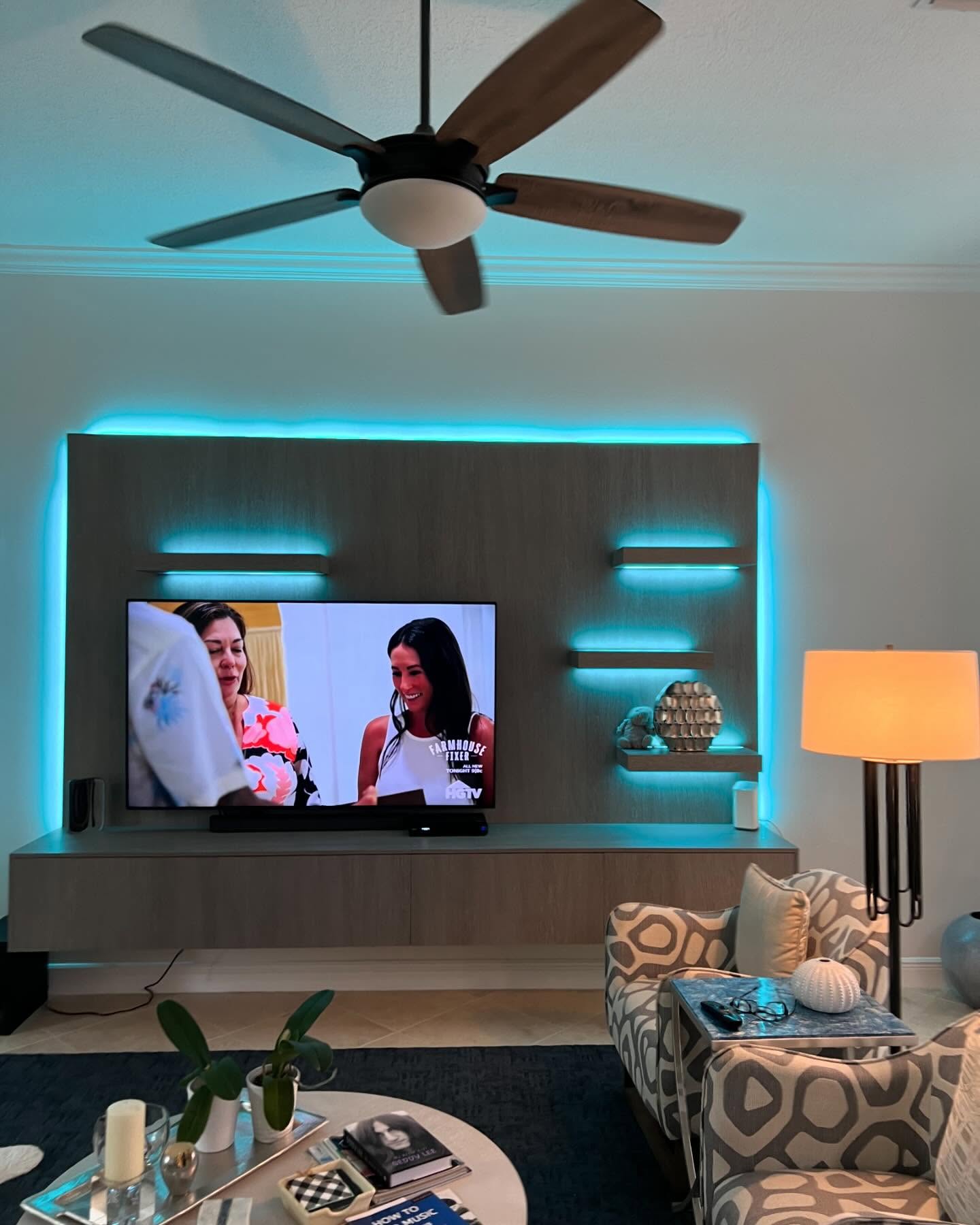
- Living room displays and media walls, often combined with a mounted TV
- Home offices and closets where you want storage without bulky cabinets
They’re not the best choice for heavy book collections across a long span. For that, a built-in bookcase or a supported shelving system is usually the better call, and we’ll tell you so.
Adding Lighting
LED strips under or behind floating shelves are popular right now, especially on media walls. Plug-in, low-voltage LED kits are simple. If you want lights hardwired to a wall switch or new outlets added behind a TV, that’s electrical work that needs a licensed electrician and may need a permit. Check current county or city requirements before planning it. We plan the shelf layout around the wiring so the shelves and the electrical work come together cleanly.
How a Professional Install Goes
On a typical floating shelf job, we:
- Talk through what the shelves will hold, how deep they need to be, and the look you want
- Locate studs, block or concrete and check for wiring and plumbing
- Choose brackets and fasteners for that specific wall
- Mount and level the brackets, since a bracket that’s slightly off shows on a long shelf
- Fit the shelf, check that it’s tight and level, then patch and touch up as needed
Cost depends on the number and length of shelves, the wall type (concrete takes more time than wood studs), whether we’re supplying custom shelves or installing ones you bought, and whether there’s patching, painting or lighting involved. We’ll give you a clear estimate after seeing the space.
Get Your Floating Shelves Installed Right
Thomas DiGiorgio Construction handles floating shelves, shelving systems, mirrors, doors, light fixtures and other installation work throughout Palm Beach County, including West Palm Beach, Palm Beach Gardens, Jupiter, Lake Worth, Boynton Beach and Delray Beach. We’re a Palm Beach County Registered General Contractor (U-22646) with Florida state contractor license RG291104146.
Call 561-528-1555 or email thomas@thomasdconstruction.com for a free estimate. Tell us what you want to hang and where, and we’ll make sure it stays there.
